
Trust, context, and autonomy with Reltio 2026.2.

As enterprise AI moves from experimentation to agents in production, success depends on more than the model you choose. It depends on whether your business can trust—and act on—the results. Models may become easier to swap, but the business context they reason over is not interchangeable. Incomplete, siloed data leaves agents without a reliable understanding of your business, creating doubt where you need confidence. Closing that gap is the work we have been focusing our innovation on.
Our 26.2 release continues to accelerate that work. Harnessing agentic AI is integral to our approach to data unification and to enabling context intelligence—not a separate layer of innovation. To reflect that approach, we’re moving away from AgentFlow as an umbrella name and referring directly to the capabilities themselves, including autonomous agents, unstructured augmentation, and custom-built agents. More specific names make it easier to understand what’s available and how it supports your goals.
Our focus remains unchanged: delivering innovations that help you unify data, unlock trusted business context, and move forward with confidence.
With 26.2, that commitment translates into advances across agentic data unification, faster paths to value, and closer integration with the SAP ecosystem. Here’s a look at what’s new and what it means for your teams.
Autonomous agents for master data governance.
In 2026.2 we’ve continued our focus on autonomous master data governance, a core part of how we build trusted context. Our prebuilt and custom autonomous agents take on routine stewardship work, continuously curating and updating your data so your business context stays current without constant manual effort.
You define the whole automation process—which agent, what instructions, and what scope. The agent proposes a plan, and you approve it once, not once per record. Then it runs: right away, on a schedule, or triggered from your own systems through the API. It processes records in parallel in the background. When it’s done, you get a record-by-record result with a status, a confidence level, and a reason. And then you act: you can approve it, ask the agent follow-up questions, and send the uncertain cases to your data stewards.
Our resolver agent, for instance, can work through potential matches and make or recommend merge decisions 24/7, reducing your backlog in big chunks. And you can build your own custom agents for different stewardship tasks, running continuously to meet your business needs.
The latest release also adds unstructured search to our unstructured augmentation capability. It turns your documents into searchable knowledge bases for Reltio’s agents and your external agents connected through our MCP server. Every answer links back to its source document.
>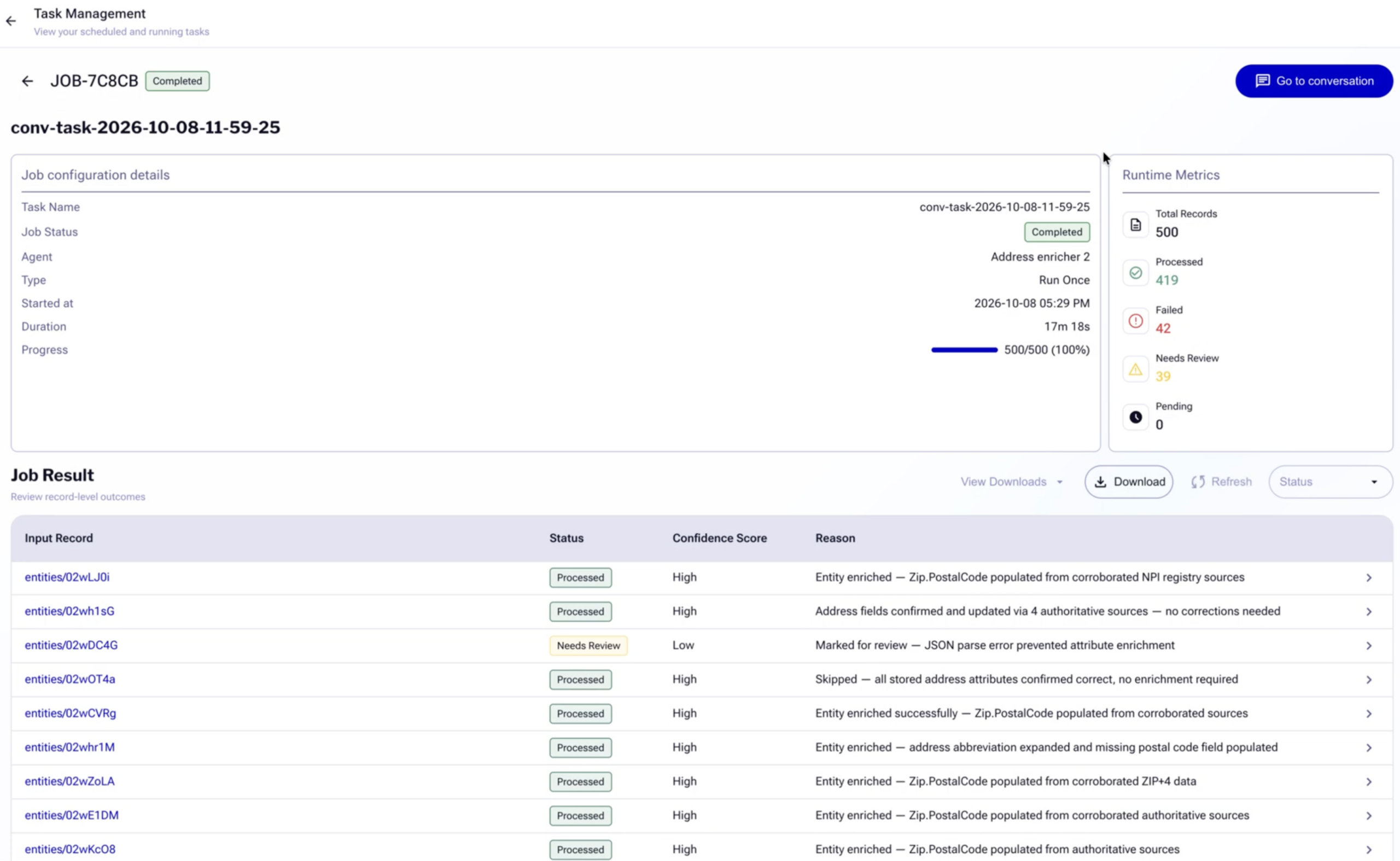
Autonomous agents at work in Reltio
Fast time to value for additional industries.
Velocity packs give teams a prebuilt starting point so they reach trusted data faster: ontologies and rules for specific industries and domains—whether or not you use SAP systems.
With the 2026.2 release, we’re announcing several new industry-focused velocity packs, including retail, CPG, mills and mining, industrial manufacturing, and utilities. We will continue growing the capabilities.
In addition, our new velocity pack for SAP S/4HANA includes a prebuilt data model aligned with its domains, plus match rules, survivorship, and cleansing configuration designed for SAP’s flagship application. The model covers 14 entity types across business partner, commercial, product, facility, and finance data, and deploys on any Reltio tenant.
Teams can use the SAP S/4HANA velocity pack in use cases where consolidating or migrating core data from multiple ERP instances is necessary, including to prepare clean, governed master data before an SAP S/4HANA transition begins and to keep that data governed across SAP and non-SAP sources after go-live. This velocity pack includes data domains for finance operations including charts of accounts, cost center, profit center, general ledger, and more.
Customers can browse our industry-specific data models and the SAP S/4HANA data model in our velocity pack builder tool.
SAP Integration Suite Adapter.
SAP Integration Suite Adapter for Reltio makes it easier for existing SAP Integration Suite customers to bring SAP Reltio’s master data into their existing data landscape. Build flows that bring source records into SAP Reltio and make unified records available to both SAP and non-SAP applications, so business teams work with more consistent information.
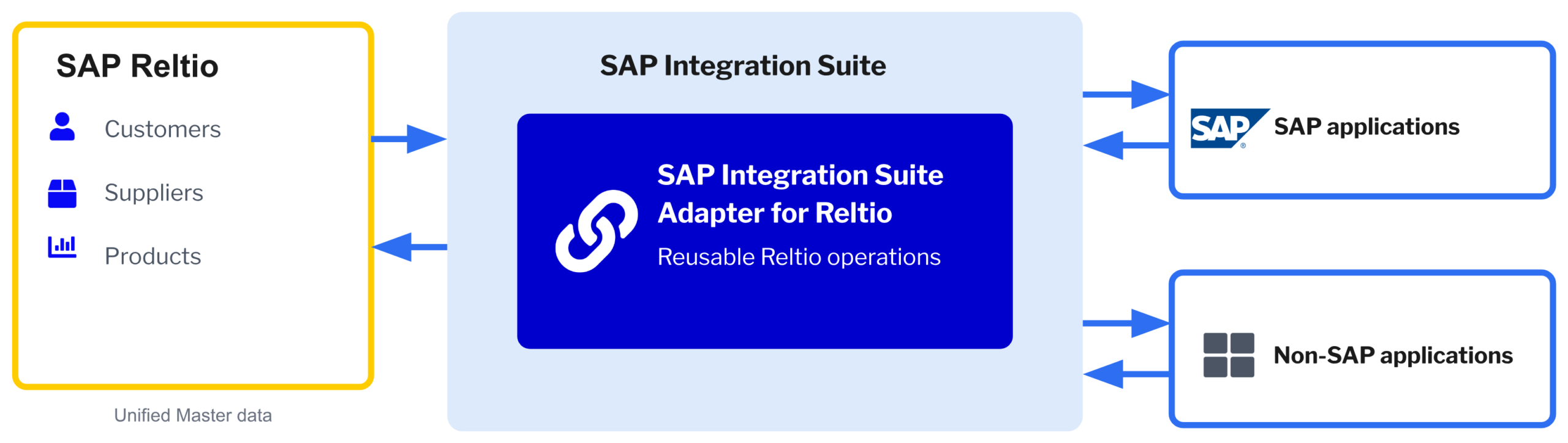
And because it works within the SAP Integration Suite environment customers already use, your teams can apply familiar development and operational practices rather than adopting a new toolset. For example, they can use built-in OAuth authentication, pagination, configurable retries, and standardized error handling to reduce custom integration code and simplify ongoing support. Connectivity is built once and reused as each new application or process builds on the work that came before, making every subsequent integration project easier to deliver.
Strengthening core capabilities.
In addition, the latest release contains several enhancements to our core capabilities, including:
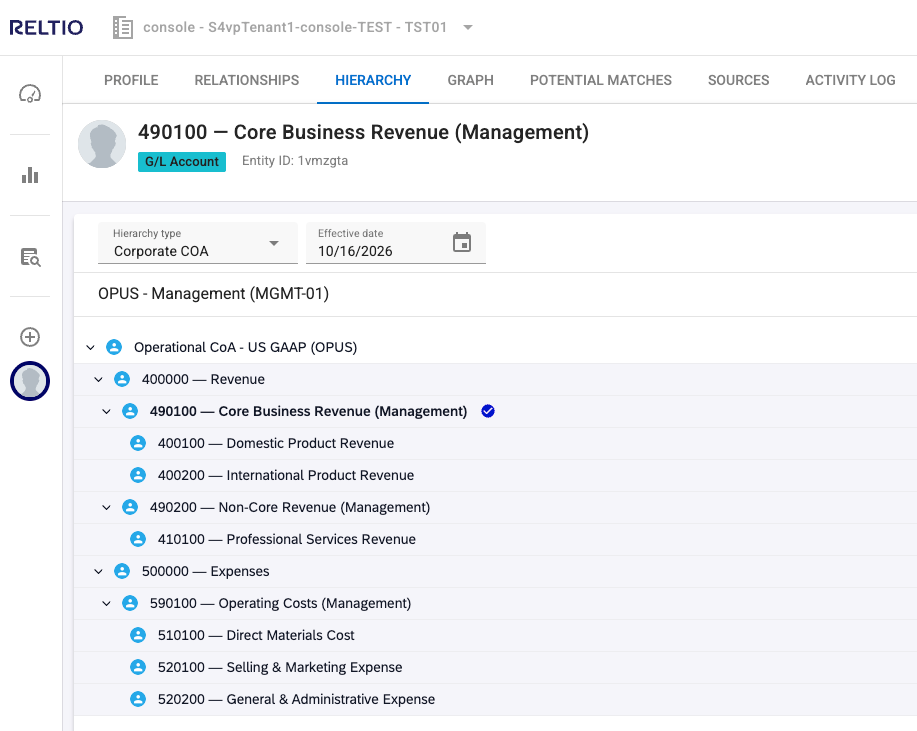
Advanced hierarchy management. With this enhanced feature, enterprises can plan future hierarchies, activate them on schedule, and preserve historical views without overwriting live structures or relying on brittle spreadsheets. This new feature provides efficiency and flexibility where structures change often or face audit scrutiny. For example, finance teams managing reporting hierarchies, M&A integration, and product portfolio changes; retailers building seasonal product catalogs; life sciences firms preparing brand, territory, and trial-site structures ahead of launches or reorganizations—among many others. The result is less operational risk and rework, faster readiness for business events, and a governed, auditable record of what any hierarchy looked like at any point in time.
Match and merge. New configurability in our flexible entity resolution network (FERN)—which now runs on AWS, Microsoft Azure, or Google Cloud—gives you greater control over matching:
- Match input control: Data stewards choose which sources, record types, and attributes are eligible for matching, and preview the impact first.
- Ordered match rule execution: Customers sequence match rules and FERN—for example, running FERN before a rule OR running a rule and then FERN.
- Score alignment: Combine normalized exact and fuzzy scores using a weighted average or formula.
Zero-copy interaction integration. With 2026.2, our zero-copy interaction integration capabilities now also reach Google BigQuery, joining Snowflake and Databricks. Interaction and transaction data stays where it already lives, and Reltio links it to the right profile in real time, so each profile shows a full interaction timeline without copying a byte.
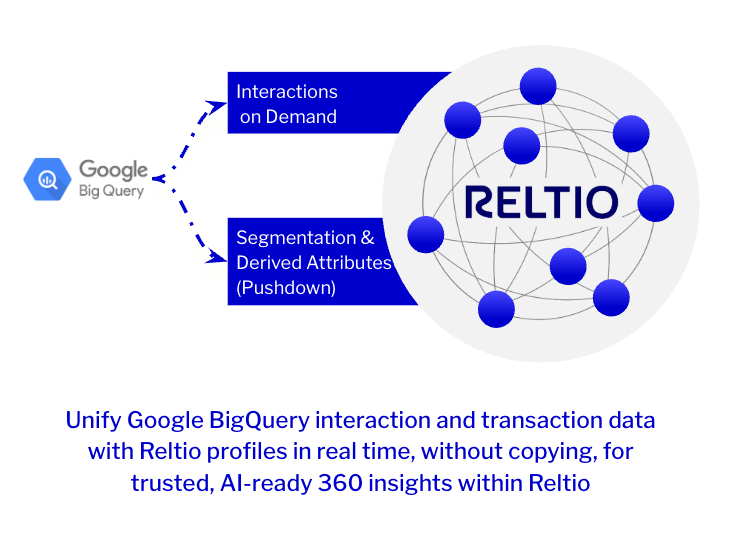
The payoff is one governed, 360° view—ready for every downstream system and agent to act on, with nothing duplicated and far less integration work to build and maintain. And because the data isn’t copied, there are fewer redundant versions of sensitive data to govern. With Databricks, early access program users can now go a step further, building fine-grained audience segments that blend profile attributes with behavioral signals like purchases and clicks.
Other enhancements to 360° profiles. With 2026.2, customers can now choose audience segmentation with additional filters on interactions. Interaction timelines now support role-based access control for interaction types, so you decide which roles can see which interactions.
Integrated development experience (IDE). Last but not least, Reltio’s new integrated development experience is an extension for VS Code and Cursor that brings our Reltio configuration into the editor developers already use. It supports guided and natural-language authoring with code completion and automatic creation of required dependencies, validates configuration as you write it, and adds navigation and an ontology view of the data model.
With the local configuration against a connected tenant, you can review the differences before applying them, and Git integration provides version control, peer review, and change history. To learn more about our AI capabilities for configuration, watch our recent community show.